Onboarding is a conversation
A crawler reads the brand’s website, local profiles, and reviews. People correct it in plain words and preview a real reply before going live.
WorkAura, 2025 – 2026
Product Designer · Team of 1 PM, 6 engineers · Sponsored by the VP of Product and CTO · Kickoff to pilot: Nov 2024 – Mar 2025 · Shipped Q2 2026.
Live interactive prototype
Follow a request from prompt to preview and approval—including onboarding, voice, and error recovery.
The tour starts when this area comes into view. Stop the tour to explore from the beginning.
These screens are a working prototype I rebuilt from my Figma files, with the product renamed “Aura”; the shipped product differs in detail. Brands are fictional.
A crawler reads the brand’s website, local profiles, and reviews. People correct it in plain words and preview a real reply before going live.
Listening, thinking, answering: a spoken request becomes a draft waiting for approval.
Built on the company’s design system, it brought Social, Reviews, Reporting, and Local Visibility into the assistant.
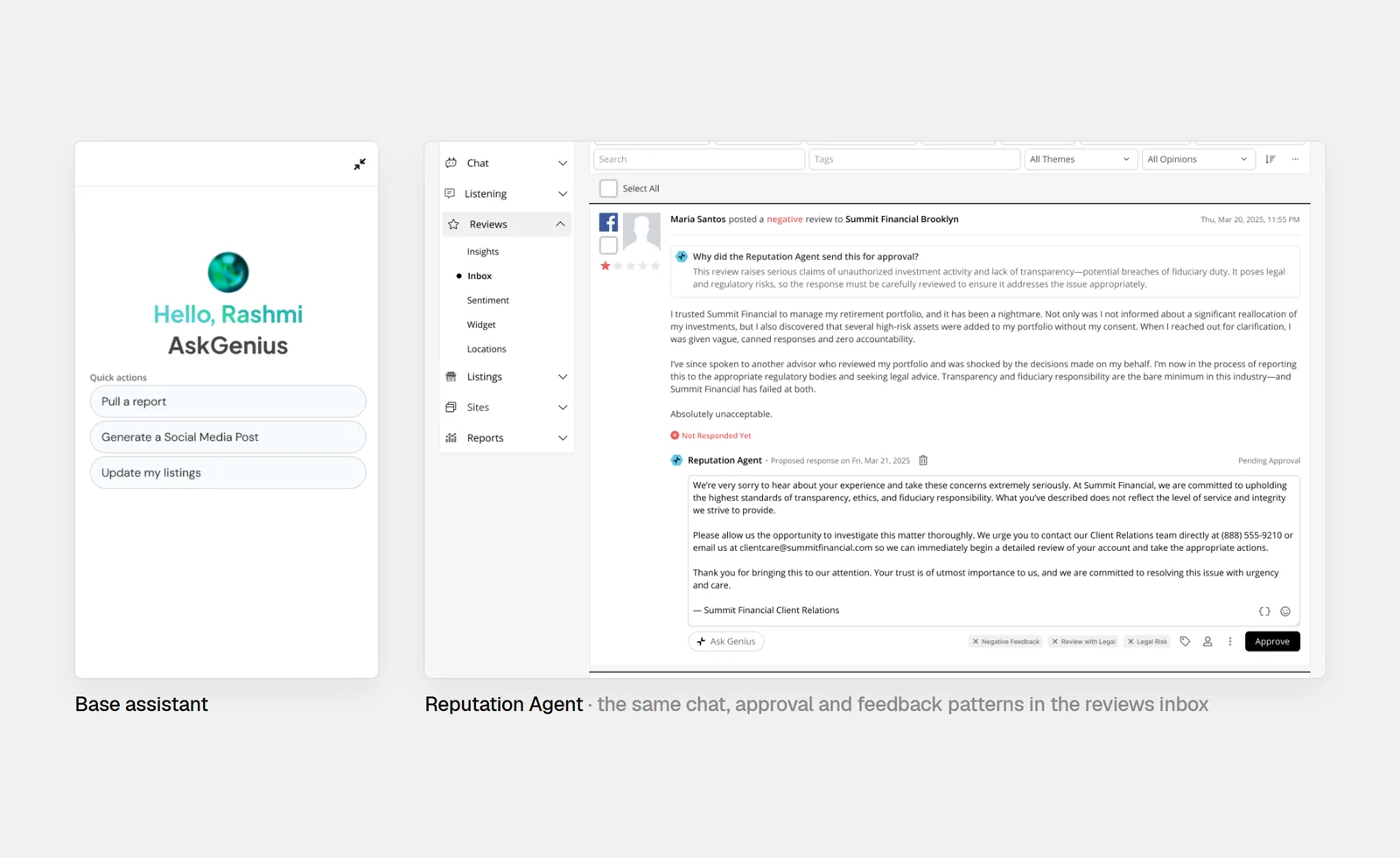
Engineering pitched a workforce of specialist agents, while Product wanted one agent per product line. I coded a live prototype of the full multi-agent workforce and tested it with regional managers—three immediately read it as more overhead: “So now I manage three virtual employees and review their work every day?” Backed by post-test survey data, we shipped one orchestrator assistant in front, with specialist agents working behind the scenes.
What it costThe multi-agent workforce UI was cut from the MVP and pushed past GA.
Eight layout placements narrowed to two in testing. With a floating window, people kept dragging the chat out of the way to see their underlying data, so we anchored the assistant in a fixed sidebar beside their workspace.
What it costThe sidebar claims roughly a quarter of the viewport, requiring tighter density across tables and inboxes.
One bad post could reach 2,478 locations. Every post renders as a live preview, and bulk updates confirm scope upfront, track progress, and isolate failed locations with retry and undo. Every rejection asks why, giving Engineering a labeled dataset of answer-quality issues.
What it costManual approval slows down high-volume teams, so we added onboarding rules that let pre-approved reply types publish automatically.
Leadership heard “AI workforce” as leverage. Regional managers heard three more employees to supervise. Removing that coordination burden first made the underlying agents far easier to trust and adopt.
In a portfolio review I walk through the research, the options we killed and the data behind each call. Ask for the walkthrough